How Paid Ads Are Shifting in the Age of LLMs

What B2B brands must understand (and do next)
Paid ads haven’t suddenly stopped working—but something underneath them has changed. Many B2B teams are seeing rising costs, lower click-through rates, and less predictable performance, even when campaigns are well-optimized. The reason isn’t just competition or platform changes. It’s how people search. Or more accurately—how they don’t search anymore. With AI tools answering questions before users ever click, the role of paid ads is quietly shifting. Understanding this shift is the difference between scaling efficiently and burning budget.
Short Answer
Paid ads are not failing—but their role has changed.
Large Language Models (LLMs) like ChatGPT, Gemini, and Perplexity now answer user questions before users click ads.
This means:
Fewer clicks from traditional search
Higher CPCs due to competition for fewer interactions
Paid ads shifting from discovery channel → demand capture channel
To stay effective, paid ads must now work alongside:
AI visibility (AEO / GEO)
Strong organic authority
Structured, answer-first content
What’s Actually Changing in Paid Ads?
Many teams are seeing the same pattern:
CPCs are rising
CTRs are declining
Conversion paths feel less predictable
The instinct is to optimize harder:
More testing. More budget. More campaigns.
But the real shift is behavioral—not tactical.
Users are no longer just searching
They are asking.
Instead of:
“best CRM software Singapore”
They now ask:
“What’s the best CRM for a 50-person SaaS team with limited budget?”
And they often get a complete answer instantly—without clicking anything.
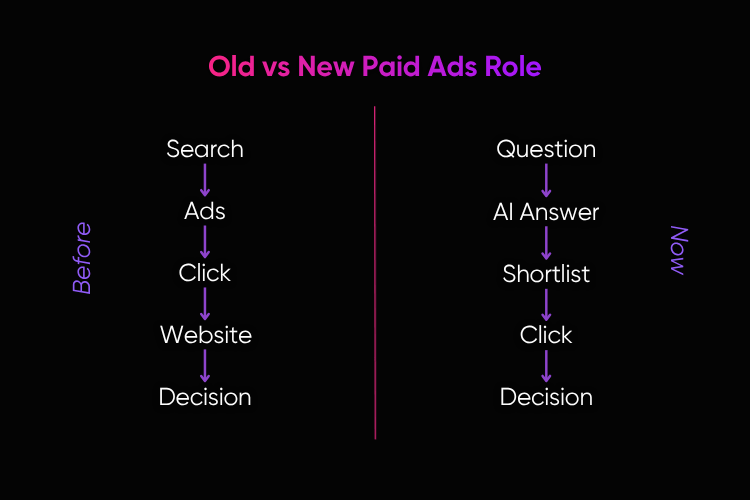
The Core Shift: From Click Economy to Answer Economy
Before (Traditional Search Model)
User searches
Sees ads + organic results
Clicks
Evaluates
Now (LLM-Driven Journey)
User asks a question
AI generates an answer
Shortlists options
Then may search or click
Paid ads are no longer the first touchpoint.
They are part of a validation layer, not discovery.
Why Paid Ads Feel Less Predictable
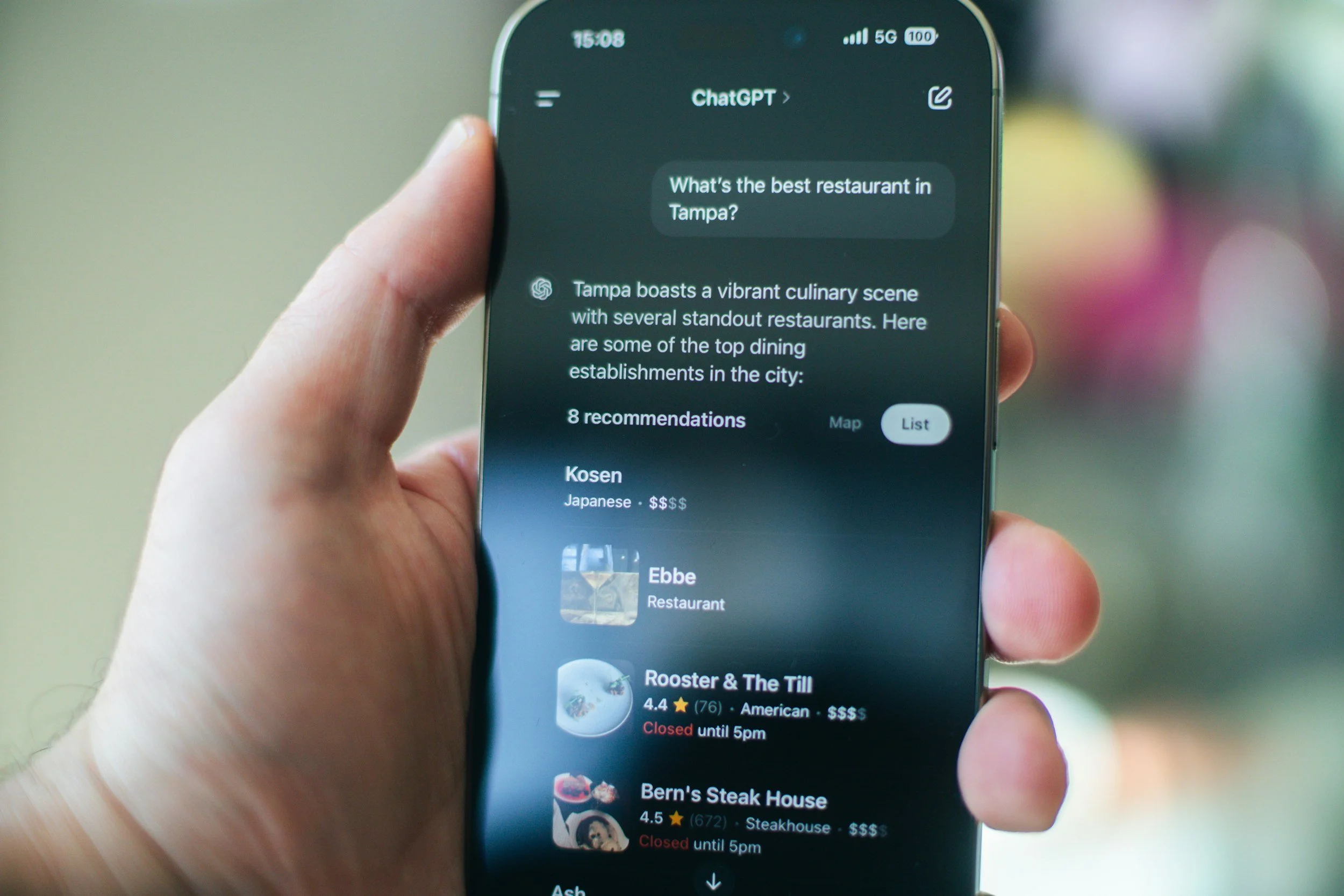
1. AI intercepts early-stage intent
Top-of-funnel queries are increasingly answered inside AI tools.
Result:
Less traffic entering Google
Less opportunity for ad impressions
2. Fewer but more qualified clicks
Users who do click:
Are further along in the decision process
Compare fewer options
Expect clarity immediately
Result:
Higher CPCs
Lower CTRs
But potentially higher intent
3. The “invisible shortlist” problem
If your brand isn’t mentioned in AI-generated answers:
You’re not even considered.
This happens before ads are shown.
Does Paid Search Still Work?
Yes. But differently.
Where Paid Ads Still Deliver Strong Value
Bottom-of-funnel queries
Competitor targeting
Retargeting campaigns
Branded search
High-intent transactional keywords
Paid search is now:
The fastest way to capture demand—not create it.
The New Paid Ads Role in 2026
Think of paid ads as part of a 3-layer system:
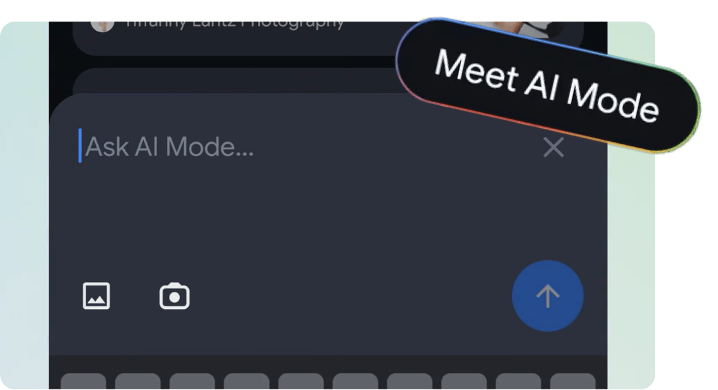
1. AI Visibility Layer (New)
ChatGPT, Gemini, Perplexity
AI Overviews (Google)
Structured answers, citations, mentions
This is where discovery happens.
2. Organic Search Layer
SEO + AEO content
Authority building
Long-term traffic
This reinforces credibility.
3. Paid Ads Layer
Capture high-intent users
Accelerate conversions
Retarget engaged audiences
This converts demand.
See also How Google’s AI Overviews & AI Mode Impact SEO
You may want to see also How to Adapt SEO for Google’s AI Overview & AI Mode
What Most B2B Companies Get Wrong
They treat paid ads as a standalone channel.
In reality:
Ads depend on visibility upstream
Visibility now starts in AI systems
If your strategy is:
“Run Google Ads and optimize landing pages”
You’re missing the first half of the journey.
How to Adapt Your Paid Ads Strategy (Without Rebuilding Everything)
1. Align Ads With AI-Touched Journeys
Assume users have already:
Seen summaries
Compared options
Built expectations
Your ads must:
Be specific
Match advanced intent
Remove friction fast
2. Shift Budget Toward High-Intent Segments
Reduce reliance on:
Broad keywords
Informational queries
Increase focus on:
Bottom-funnel keywords
Solution-based searches
Retargeting audiences
3. Build “Answer-Led” Landing Pages
Your landing page should feel like: a continuation of an AI answer—not a sales pitch.
Include:
Direct answers upfront
Structured sections
Clear differentiation
Proof (data, case studies)
4. Integrate SEO + AEO + Paid (This is critical)
Your paid performance now depends on:
Whether AI mentions your brand
Whether your content is extractable
Whether your authority is recognized
This is where most campaigns fail.
5. Optimize for “Inclusion,” Not Just Clicks
The new competition is:
Not just who gets the click—but who gets recommended.
That means:
Structured content
Clear positioning
Strong entity signals
Consistent messaging across channels

What This Means for Your 2026 Strategy
If your paid ads are underperforming, it’s not always a campaign issue.
It’s often a visibility issue.
You’re competing in:
Google
AI Overviews
ChatGPT
Perplexity
Gemini
At the same time.
Foundcoo’s Perspective
We’re seeing a clear pattern across B2B clients in Asia:
Companies investing only in ads → rising costs, unstable results
Companies combining AI SEO + paid → stronger pipeline, lower dependency on ads
The difference is simple:
One is buying visibility.
The other is building it.
FAQs
-
No. They are evolving. Paid ads are still effective for capturing demand but are no longer the primary discovery channel.
-
Because fewer users are clicking. AI tools are absorbing early-stage traffic, making competition for remaining clicks more intense.
-
Not necessarily. But you should rebalance your strategy to include AI visibility and organic authority.
-
Neither works in isolation anymore. The highest-performing strategies combine:
SEO (visibility)
AEO (AI inclusion)
Paid ads (conversion)
-
Look for:
Declining CTRs
Stable impressions but fewer clicks
Longer conversion paths
Increased branded searches
Final Thought
You’re not just competing for clicks anymore.
You’re competing to be:
Mentioned
Recommended
Trusted
Before the user even reaches Google.
Want to See Where You Stand?
At Foundcoo, we analyze:
Your AI visibility across platforms
Your paid ads performance gaps
Your full demand capture system
If your ads feel more expensive and less predictable, this is usually why.
Let’s fix the root cause—not just the campaign.
Want to understand how your brand appears in AI-driven search and recommendations? Let’s review it together.
Foundcoo helps B2B and industrial brands measure, improve, and sustain visibility across AI-driven search platforms beyond rankings and one-off snapshots.
If you want clarity instead of guesswork, let’s talk.