Why Online Communities Now Shape Brand Visibility
Online communities are no longer just places where people chat, share opinions, or ask casual questions.
They have become discovery engines.
They influence what people trust, what they search for, which brands they consider, and increasingly, what AI tools may surface in response to buyer questions.
For B2B companies, this matters more than many teams realise.
A buyer looking for a marketing agency, software provider, industrial equipment manufacturer, engineering solution, or technical service may not start by visiting your website. They may ask ChatGPT for recommendations, check LinkedIn discussions, scan Reddit, niche forums or online communities, watch YouTube breakdowns, compare review platforms, and only then visit your website.
By the time they land on your page, their opinion may already be half-formed.
That is why visibility today does not start only on your website. It starts wherever your audience learns, compares, validates, and asks for real-world advice.
Online communities are becoming part of the modern search journey because they influence what people trust before they ever visit a company’s website.
A recent Clutch study on online community behavior found that 95% of regular online community users have discovered helpful information in communities, and 98% have some level of trust in product or service recommendations from other members.
That tells us something important: people are not only searching for brands anymore. They are searching for proof.
They want to see what others say, how brands respond, whether the advice feels honest, and whether the company shows up with value instead of just promotion.
This is where many brands get community marketing wrong. They enter discussions with the mindset of promoting, when the real opportunity is to be genuinely useful. A simple test is this: if you removed the company name from your comment, would it still help someone? If the answer is yes, the brand is showing up in the right way.
Another Clutch article on why people join online communities shows that learning tips and gaining knowledge are among the strongest motivations for joining these spaces. For brands, this matters because people are not joining communities to receive another sales pitch. They are joining because they want clarity, practical advice, shared experience, and answers they can actually use.
For B2B companies, this is especially important.
A buyer may discover your expertise through a LinkedIn discussion, a niche forum, a review platform, a Reddit thread, or an expert comment long before they enquire. These touchpoints shape trust, influence search behavior, and increasingly contribute to how AI tools understand your brand’s authority.
Table of Contents
What Are Online Communities in Modern Marketing?
Why Online Communities Matter for AI Search and LLM Visibility
Why Community Trust Matters for Brands
The B2B Buyer Journey Has Changed
Online Communities Are Not Just for B2C Brands
How Online Communities Support SEO
How Online Communities Support AEO and GEO
The Right Way for Brands to Participate in Communities
What This Means for Foundcoo’s Clients
Practical Framework: How to Use Online Communities for Search Visibility
Example: How a B2B Brand Can Apply This
Common Mistakes Brands Make With Online Communities
How to Measure Whether Community Visibility Is Working
What Are Online Communities in Modern Marketing?
Online communities are digital spaces where people gather around shared interests, problems, identities, industries, or goals.
They can include:
LinkedIn groups and professional conversations
Reddit communities
Facebook groups
Slack or Discord communities
Review platforms
Industry forums
Niche technical communities
Customer communities
Creator-led communities
Comment sections around expert content
For B2B brands, the most important communities are not always the biggest ones. They are the ones where your buyers ask questions before they are ready to speak to sales.
An engineer may ask other engineers which vibration testing setup is reliable.
A marketing manager may ask peers which agency understands AI search.
A sustainability lead may ask which platform helps with ESG reporting.
A facility manager may ask which waterproofing system works best in a tropical climate.
These conversations may not happen on your website, but they can influence whether your website gets visited at all.
Why Online Communities Matter for AI Search and LLM Visibility
AI search tools are changing how people discover companies.
Instead of typing one keyword into Google and clicking through ten blue links, buyers now ask full questions such as:
“Which B2B marketing agencies understand AI SEO in Southeast Asia?”
“What are the best ways to improve visibility in AI search?”
“Which brands are trusted for industrial testing equipment?”
“How should a company build authority beyond its website?”
AI tools look for patterns across multiple sources. They are more likely to surface brands that are consistently mentioned, clearly explained, trusted by third-party sources, and associated with useful expertise.
That means your website still matters, but it is no longer enough on its own.
Your visibility is shaped by your wider digital footprint, including:
Your website content
LinkedIn posts
Third-party articles
Review platforms
Community discussions
Expert quotes
Case studies
Digital PR
Videos
Social engagement
Forum mentions
Customer language
This is where online communities become important for Generative Engine Optimization, Answer Engine Optimization, and modern SEO.
Communities create real-world signals. They show what people ask, what they trust, what language they use, what objections they have, and what problems they are trying to solve.
For AI systems and search engines, those signals can help shape brand relevance.
For marketing teams, they are a source of strategy.
This is why community visibility should not sit separately from your search strategy. A strong AI SEO and traditional SEO strategy helps your brand become easier to understand across Google, AI Overviews, ChatGPT, Gemini, Perplexity, and other discovery platforms.
Why Community Trust Matters for Brands
The strongest lesson from online community behavior is simple: people stay where they receive value.
In Clutch’s article on what motivates people to join online communities, 69% of respondents said they join communities to learn tips and gain knowledge, while 65% join to connect with like-minded people. Discounts and promotions ranked much lower, at 26%.
That says a lot about how brands should behave.
People are not joining communities because they want another sales message. They join because they want useful answers, shared experience, practical advice, and conversations that help them make better decisions.
This is where many brands make the wrong move.
They enter communities with announcements, offers, product links, and polished marketing language. But community members are usually looking for something more human and more useful.
They want to know:
Has someone solved this problem before?
What worked in a real situation?
What should I avoid?
Can I trust this advice?
Is this brand helping, or just trying to sell?
Clutch’s research on online community behavior also found that too much promotional content is one of the biggest frustrations for community members. That makes sense. Communities are built on participation, not interruption.
For brands, the better approach is to show up with value first.
A useful way to think about it is this: if you removed your company name from the comment, post, or answer, would it still help someone?
If yes, the brand is contributing.
If no, it is probably just advertising in a place where people came for conversation.
This matters even more in B2B. Buyers are often researching complex, high-value decisions. They are looking for clarity, proof, and confidence before they ever speak to a sales team.
A helpful answer in a LinkedIn discussion, a thoughtful comment in an industry forum, or a clear explanation in a third-party article can shape how a buyer sees your brand long before they visit your website.
That is why community visibility must be earned.
Not by posting more.
But by helping better.

The B2B Buyer Journey Has Changed
In B2B, the buyer journey is rarely linear.
A decision-maker may first become aware of a problem through a LinkedIn post.
Then they may ask ChatGPT what solutions exist.
Then they may check Google.
Then they may read a comparison article.
Then they may ask a private group for recommendations.
Then they may visit review platforms.
Then they may finally land on your website.
This means your brand needs to be visible before the buyer is ready to convert.
Not just at the final search stage.
For example, a Head of Marketing in Singapore may not search “Foundcoo digital marketing agency” immediately.
They may first search or ask:
“Why is our website traffic not converting?”
“How do I know if my company appears in AI search?”
“What is the difference between SEO, AEO, and GEO?”
“How can a B2B company get visibility in ChatGPT?”
“Which agencies understand AI search for B2B companies?”
If Foundcoo has useful content across its website, LinkedIn, third-party mentions, and community discussions, the brand has more chances to appear during this discovery process.
That is the new search environment.
Online Communities Are Not Just for B2C Brands
Many companies still associate online communities with consumer brands, hobbies, lifestyle products, or creators.
But B2B communities are often even more influential because the buying decision is more complex.
B2B buyers want reassurance before they enquire.
They want to know:
Has anyone solved this problem before?
Is this provider credible?
Does this company understand my industry?
Are they just selling, or do they actually know what they are talking about?
Can I trust them before booking a call?
This is especially true for high-value services such as marketing, SEO, AI visibility, engineering systems, industrial equipment, software, consulting, and technical solutions.
The more complex the purchase, the more buyers seek validation outside the brand’s own website.
That validation often happens in community spaces.
How Online Communities Support SEO
Online communities can support SEO in several ways.
First, they reveal the language people actually use.
Your audience may not search the way your internal team writes. Community discussions show real questions, frustrations, comparisons, objections, and decision criteria.
Second, communities help identify content gaps.
If people keep asking the same question in LinkedIn comments, Reddit threads, or industry groups, that question may deserve a website article, FAQ section, comparison guide, or LinkedIn post.
Third, communities can influence branded search.
When people see your brand mentioned in useful conversations, they may later search your company name directly.
Fourth, communities can support topical authority.
If your brand consistently explains a topic across your website, LinkedIn, third-party content, and expert contributions, search engines and AI systems have more context to understand what your brand should be associated with.
Fifth, community insights make content more helpful.
Google and AI tools are increasingly rewarding content that satisfies real user intent. Community discussions show what that intent actually looks like.
How Online Communities Support AEO and GEO
AEO, or Answer Engine Optimization, is about making your content easy to extract as a direct answer.
GEO, or Generative Engine Optimization, is about helping AI tools understand, trust, and mention your brand in generated responses.
Online communities support both because they help brands create content that reflects how people naturally ask questions.
Instead of only targeting keywords like:
“AI SEO agency Singapore”
A community-informed strategy also answers questions like:
“How do I know if my brand is invisible in AI search?”
“Why does ChatGPT mention my competitors but not my company?”
“Do backlinks still matter for AI visibility?”
“Should B2B companies invest in LinkedIn, SEO, or GEO first?”
“How can small B2B teams compete in AI search?”
These are the types of questions buyers ask before they become leads.
When your website answers them clearly, your content becomes more useful for both humans and AI systems.
We explored this challenge further in our article on why AI search visibility is becoming less predictable, especially for B2B brands that depend on trust, authority, and clear positioning.

The Right Way for Brands to Participate in Communities
The wrong way is simple:
Join a group. Drop a link. Promote your service. Leave.
That does not build trust.
The better approach is slower, but more effective.
1. Listen First
Before posting, observe what people discuss.
Look for:
Common questions
Repeated complaints
Misunderstandings
Buying objections
Competitor mentions
Language patterns
Content gaps
Unanswered questions
This research can shape your SEO, content, LinkedIn, paid ads, and sales messaging.
2. Answer Without Selling First
If someone asks a question, answer the question.
Do not force your product into every response.
A useful answer builds more trust than a promotional pitch.
For example, instead of saying:
“Foundcoo can help with AI SEO. Contact us.”
A better response would be:
“If your company is not appearing in AI search, check whether your website clearly explains who you help, what problems you solve, whether you have structured FAQs, third-party mentions, and content that answers decision-stage questions. AI tools need clear context before they can confidently associate your brand with a topic.”
That type of answer is useful even without the brand name.
For many B2B companies, LinkedIn is the most practical place to start because it combines personal expertise, professional trust, and industry conversation. A consistent B2B social media strategy helps your brand show up with useful content before buyers are ready to enquire.
3. Turn Community Questions Into Website Content
If one person asks a question publicly, many others may be wondering the same thing privately.
Each repeated community question can become:
A blog article
A LinkedIn post
A carousel
A short video
A FAQ block
A landing page section
A lead magnet
A sales enablement answer
This creates a strong loop between community listening and search visibility.
4. Build Authority Through People, Not Only Pages
Communities trust people more than logos.
Your company page matters, but your team’s voices matter too.
Founders, directors, engineers, consultants, product specialists, and client-facing experts can all build authority by sharing practical knowledge.
This is especially powerful on LinkedIn, where personal profiles often travel further than company pages.
5. Avoid Over-Promotion
Promotional content has a place, but it should not dominate your community strategy.
Use a simple rule:
For every promotional post, publish several posts that educate, clarify, explain, or help.
If your audience only hears from you when you want something, they will stop listening.
What This Means for Foundcoo’s Clients
For Foundcoo, online communities are not separate from SEO, AI search, social media, or lead generation. They are part of the same visibility ecosystem. This is why a modern B2B strategy should connect AI search visibility, social media management, content strategy, digital PR, and conversion-focused lead generation.
This is especially important for B2B companies with complex services or technical products.
Your buyers may not convert the first time they see you.
But if they repeatedly see your brand associated with helpful answers, clear expertise, and trusted third-party signals, you become easier to remember and easier to trust.
That is how community visibility turns into enquiries.
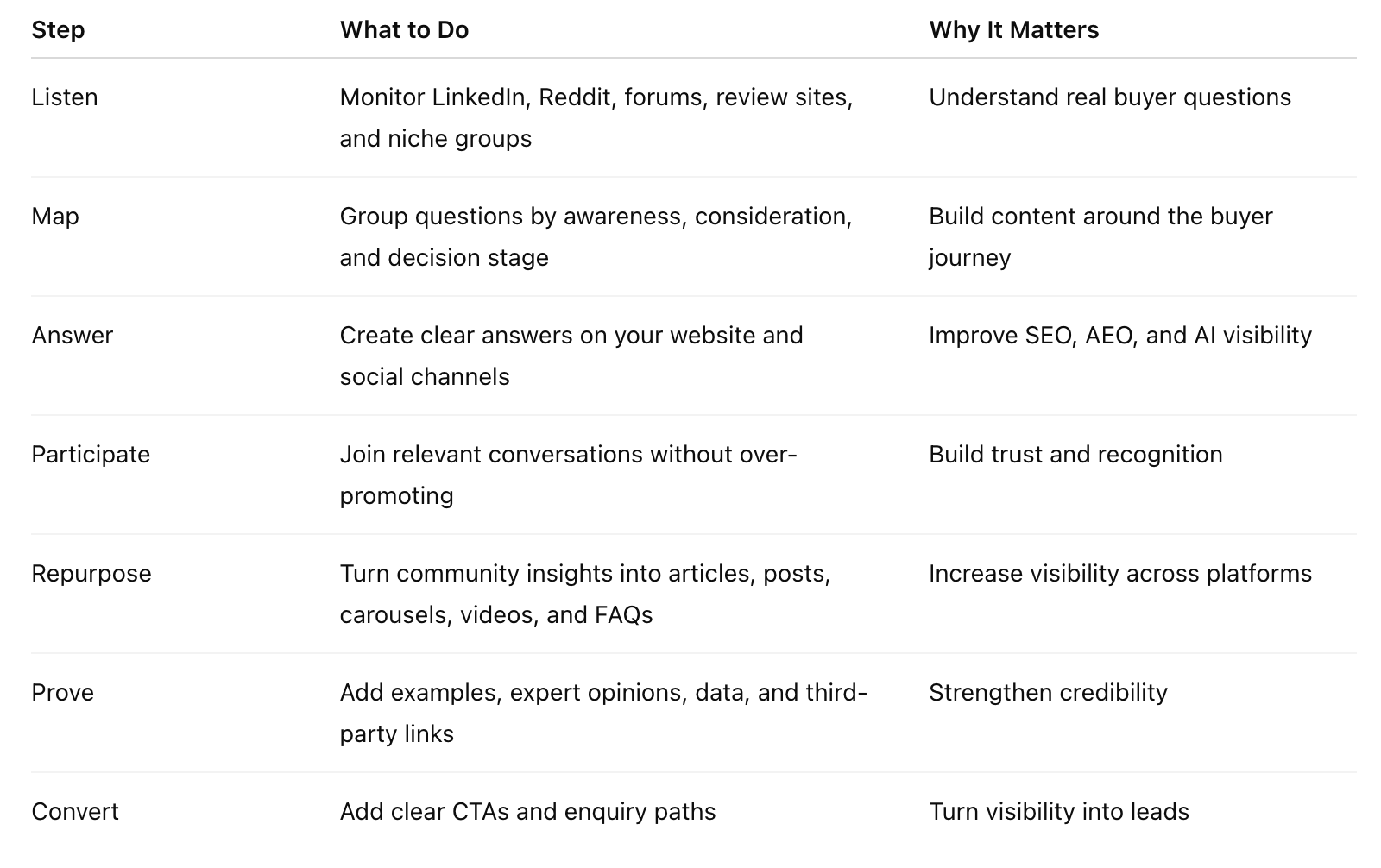
Practical Framework: How to Use Online Communities for Search Visibility
Here is a simple framework B2B companies can use.
Example: How a B2B Brand Can Apply This
Imagine a company selling technical equipment to engineering teams.
Instead of only publishing product announcements, the company could monitor what engineers ask in forums, LinkedIn comments, and technical groups.
They may find questions like:
“How do I choose the right test system?”
“What causes poor repeatability in testing?”
“What standards should I consider?”
“Which setup is better for this application?”
“What mistakes should we avoid before buying?”
Each question can become a search-optimized article, a LinkedIn post, a comparison table, a short explainer video, and a sales conversation starter.
This helps the company show up before the buyer is ready to request a quote.
That is the real value of community-informed search strategy.
This is the same principle behind a strong multi-channel growth strategy for a technical B2B brand: website content, SEO, social media, and authority-building work better when they support the same buyer journey.
Common Mistakes Brands Make With Online Communities
Mistake 1: Treating Communities Like Ad Channels
Communities are not billboards. They are conversations.
If your only goal is to push your offer, people will notice quickly.
Mistake 2: Creating Content Without Listening
Many brands publish content based on what they want to say, not what buyers need to know.
Community listening fixes this.
Mistake 3: Ignoring Existing Interest-Based Communities
Clutch found that 69% of community users participate most often in interest-based communities, while only 14% participate most in brand-led communities.
This means brands do not always need to build their own community first. Often, the smarter move is to participate where the audience already is.
Mistake 4: Using a Corporate Tone Everywhere
Each community has its own culture.
A polished corporate message may work on your website, but feel out of place in a discussion thread.
Adapt your tone without losing your expertise.
Mistake 5: Not Connecting Community Insights Back to SEO
Community insights should not stay in a spreadsheet.
They should influence your content calendar, website FAQs, landing pages, LinkedIn posts, paid ad messaging, and sales enablement.
How to Measure Whether Community Visibility Is Working
Community-driven visibility is not always measured by direct clicks alone.
Look at a wider set of signals:
Growth in branded search
More direct traffic
More LinkedIn profile and company page views
Higher engagement on educational posts
More mentions in community spaces
More referral traffic from third-party platforms
More qualified enquiries
More AI search visibility for non-branded prompts
More appearances in Google AI Overviews or answer-style results
Better conversion rates from visitors who already know your brand
The goal is not just to “be active” in communities.
The goal is to become a trusted answer in the places where buyers form opinions.
FAQs About Online Communities and AI Search
-
Yes. Online communities influence SEO by shaping search behaviour, branded demand, content ideas, peer validation, and third-party visibility. They also reveal the real questions people ask before they visit a website.
-
They can. AI tools often rely on broad digital signals to understand brands, topics, expertise, and trust. If a brand is consistently discussed, cited, and associated with useful information across credible sources and communities, it may strengthen its AI visibility.
-
Not every B2B company needs an active Reddit strategy, but many should at least listen. Reddit and other forums can reveal customer language, objections, competitor comparisons, and content opportunities.
-
Yes. LinkedIn functions as a professional community where people share expertise, ask questions, evaluate providers, and build trust. For B2B brands, LinkedIn is often one of the most important community-driven discovery platforms.
-
Most brands should start by joining and learning from existing communities. Building a brand-led community can work, but only when there is a clear reason for people to participate beyond the brand itself.
-
Educational, practical, experience-based content works best. People respond to answers, examples, frameworks, troubleshooting advice, and honest perspectives more than direct promotion.
-
Community insights help brands write content based on real buyer questions. They can be used to create FAQ sections, comparison articles, thought leadership posts, landing page copy, lead magnets, and answer-first content for AI search.
-
Buyers often trust a brand before they enquire. Community visibility helps create that trust earlier in the journey, making enquiries warmer and more qualified.
Final Thought
Online communities are not a side channel anymore.
They are part of how people search, learn, compare, and decide.
For B2B brands, this means SEO cannot live only on the website. AI visibility cannot depend only on keywords. Lead generation cannot rely only on ads.
The brands that win visibility now are the ones that show up with useful answers across the full discovery journey.
That means listening before posting.
Helping before selling.
Answering before pitching.
And building a presence that is valuable even when the logo is removed.
At Foundcoo, we help B2B companies improve visibility across Google, AI search, LinkedIn, and the wider digital spaces where buyers make decisions.
If your brand is visible on your website but missing from the conversations that shape buyer trust, it may be time to rethink your search strategy.
Want to understand how your brand appears in AI-driven search and recommendations? Let’s review it together.
Foundcoo helps B2B and industrial brands measure, improve, and sustain visibility across AI-driven search platforms beyond rankings and one-off snapshots.
If you want clarity instead of guesswork, let’s talk.