
How AI Is Reshaping the B2B Vendor Shortlist

How AI Builds the B2B Vendor Shortlist Before Buyers Contact Sales
The B2B vendor shortlist is increasingly being created before a prospect ever speaks to sales. A buyer who once opened Google and visited five supplier websites may now begin with a question such as: “Which companies can solve this problem, and which three should I evaluate?”
AI can explain the category, identify possible solutions, suggest vendors, compare their strengths and help the buyer prepare questions for a sales conversation. That changes where B2B companies need to compete.
Being visible when someone searches your company name is no longer enough. Your business also needs to be understood when a buyer asks about the problem you solve, the use case you support, the market you serve, the alternatives available and the criteria they should use to choose a supplier.
Recent research illustrates how far this behaviour has developed. Semrush surveyed 643 U.S. B2B professionals in March and April 2026 and retained 622 valid responses. Its detailed AI-buying findings are based on the 519 respondents who said they use AI for work. Among those respondents, 66% regularly used AI to research products, vendors or solutions, 92% said AI had shaped their vendor shortlist and 83% said it influenced their final vendor decision.
The study is U.S.-based, so it should not be interpreted as proof that B2B buyers across Hong Kong, Singapore or Asia behave identically. But it provides a strong signal of a wider change: AI is becoming part of vendor discovery and evaluation, not simply a tool for answering informational questions.
For B2B and industrial companies, this introduces a new commercial question: If a potential customer asks AI to recommend companies like yours, are you part of the shortlist?
Answer Summary: How Does AI Affect the B2B Vendor Shortlist?
AI can influence vendor selection at several points before a buyer contacts sales:
Problem discovery — helping the buyer understand what is wrong.
Category exploration — identifying possible ways to solve it.
Vendor discovery — surfacing companies that appear relevant.
Shortlist comparison — comparing suppliers against requirements.
Verification — checking websites, search results, case studies, reviews and external sources.
Contact decision — deciding which companies are credible enough to approach.
There is no universal formula that determines which company an AI platform will recommend. Different AI systems, prompts, sources, contexts and follow-up questions can produce different answers.
The goal therefore should not be to chase a mythical “#1 AI ranking.”
The goal is to create a digital presence that makes your company:
Easy to discover.
Easy to understand.
Relevant to specific use cases.
Supported by evidence.
Consistent across sources.
Easy to compare.
Credible when buyers verify it.
Easy to contact when they are ready.
That is a much bigger task than inserting a few keywords into a service page.

Table of Contents
The B2B Buying Journey Is Moving Upstream
Sales teams often think competition begins when an enquiry arrives. Increasingly, it begins much earlier.
According to the Semrush B2B AI buying study, respondents use AI throughout the purchasing journey: 72% during early research, 62% when actively comparing vendors and 45% while supporting the final decision. Among AI-assisted vendor research activities, respondents reported exploring possible solutions, comparing vendors, understanding a problem or category, summarising options and requesting recommendations.
This means a company can effectively lose a potential opportunity without ever knowing that the opportunity existed.
There was:
No website session.
No contact form.
No lost opportunity in the CRM.
No sales conversation.
No rejected proposal.
The company simply never became one of the options the buyer investigated. That is why AI-search visibility is becoming a commercial issue, not merely an SEO metric.
We explored the broader measurement challenge in AI Search Visibility Is Now a Marketing Intelligence Problem.
Does AI Really “Choose” Which B2B Vendors to Recommend?
Not in the way a procurement manager creates a fixed spreadsheet and ranks suppliers from one to ten.
There is no single published formula for “AI vendor ranking” that applies across ChatGPT, Gemini, Perplexity, Copilot and other AI systems.
The answer can depend on:
The platform being used.
The wording of the prompt.
Previous conversation context.
Whether live web search is involved.
Which sources are available.
How clearly those sources describe the vendor.
The location or market in the question.
Required features or technical constraints.
Follow-up questions from the buyer.
ChatGPT Search, for example, can search the web for current information and provide links to relevant sources. OpenAI also recommends reviewing those sources when making decisions. However, OpenAI does not publish a formula that businesses can use to guarantee inclusion in a vendor recommendation.
This distinction matters.
Traditional SEO asks:
“Can this page rank for this search?”
AI vendor discovery asks:
“Does the available information give the system enough reason to consider this company relevant to this particular situation?”
The second question is much more contextual.
That is also why one successful AI prompt test proves very little.
As we explain in AI Search Is Inconsistent and That Changes Visibility, companies should measure recurrence across prompt clusters rather than treating one recommendation screenshot as a permanent ranking.
The Six Stages of an AI-Assisted B2B Vendor Shortlist
1. Problem Discovery: “What Is Actually Causing This?”
The buying journey often starts before the buyer knows which product or service category they need.
An industrial company may ask: “Why are our vibration test results inconsistent at higher frequencies?”
A marketing director may ask: “Why is our website traffic increasing but qualified B2B enquiries are not?”
A manufacturer expanding internationally might ask: “What usually prevents European e-commerce brands from scaling successfully in Southeast Asia?”
At this stage, the buyer is not asking for vendors.
They are trying to understand the problem.
What your business needs at this stage
Create content that demonstrates genuine problem-solving expertise:
Technical explainers.
Diagnostic articles.
Troubleshooting guides.
“Why does this happen?” content.
Industry-specific educational resources.
Definitions with practical context.
Common mistakes.
Failure modes.
Decision trees.
Expert commentary.
Avoid writing every article around your product.
If every explanation immediately becomes a sales pitch, the content becomes less useful.
The first objective is to become a credible source of understanding.
For industrial and technical businesses especially, explaining why something fails can build more authority than publishing another page describing product features.
2. Category Exploration: “What Type of Solution Do I Need?”
Once the problem is understood, the question changes.
The buyer begins exploring possible approaches.
For example:
“Should we use MIMO or single-axis vibration control for this application?”
“Should we hire a B2B SEO agency or build an internal search team?”
“Do we need Shopify Plus, custom development or a headless e-commerce architecture?”
At this stage, the buyer is comparing solution categories, not necessarily brands.
What your business needs
Build content around choice:
Solution guides.
Technology comparisons.
“X vs Y” articles.
When-to-use guides.
Selection criteria.
Advantages and limitations.
Compatibility information.
Technical requirement pages.
Cost drivers.
Implementation considerations.
This is where companies should resist the temptation to claim that their solution is always the best. A trustworthy article explains when a solution is appropriate and when it is not. That creates something both buyers and AI systems can use when evaluating fit.
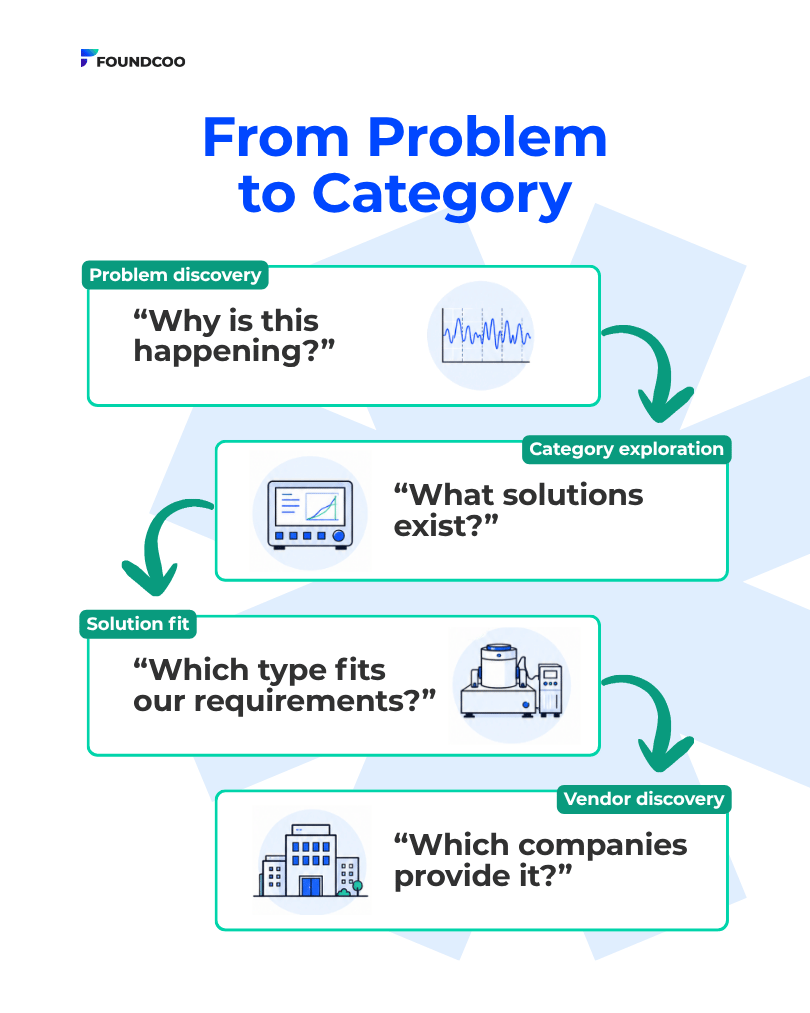
3. Vendor Discovery: “Which Companies Can Do This?”
Now the commercial opportunity becomes more obvious.
The buyer may ask: “Which B2B marketing agencies specialise in industrial companies in Asia?”
Or: “Which suppliers offer vibration testing systems suitable for automotive component validation?”
Or: “Which agencies can build Shopify e-commerce infrastructure with PIM, OMS and 3PL integrations in Asia?”
At this point, clarity becomes critical.
An AI system—or a human researcher—needs to determine:
What the company actually provides.
Which industries it serves.
Which problems it solves.
Where it operates.
Which technologies it supports.
Whether it has relevant experience.
Whether independent sources support those claims.
A homepage saying: “We deliver innovative solutions that transform tomorrow.” provides almost no useful information for this task.
Compare that with: “B2B and industrial digital marketing agency headquartered in Hong Kong, working across Singapore and APAC, specialising in SEO, AI-search visibility, paid media and digital growth for technical companies.”
The second description provides entities, markets, services, industries and context.
Foundcoo itself is positioned around B2B and industrial digital marketing across Hong Kong, Singapore and APAC, supported by its own AI marketing intelligence platform, Claryx.
What your business needs
At vendor-discovery stage, strengthen:
Homepage positioning.
Service pages.
Industry pages.
Application pages.
Location and market information.
About page.
Team expertise.
Technology partnerships.
Customer evidence.
Third-party company profiles.
Consistent descriptions across the web.
Your website remains the foundation, but it should not be the only source explaining what your company does.
4. Shortlist Comparison: “Which Three Should I Evaluate?”
This is one of the most commercially important AI-search moments.
The buyer has identified several companies. Now they begin narrowing them. Prompts become more specific: “Compare these three agencies for a B2B industrial company entering Southeast Asia.”; “Which vendor is more suitable if we need local technical support and customised integration?”; “Compare these software platforms based on API support, implementation time and price.”
Semrush's study found that 61% of respondents who use AI for vendor research directly compare vendors, while 56% reported asking for direct comparisons in their prompts. Many also include practical constraints such as budget, required capabilities or compatibility.
This matters because generic authority is no longer enough.
A buyer may not ask: “Who is the biggest provider?”
They may ask: “Which provider is best for my particular situation?”
What your business needs
Give buyers enough information to evaluate fit:
Detailed service pages.
Product specifications.
Use-case pages.
Comparison guides.
Pricing signals.
Implementation process.
Typical project scope.
Regional coverage.
Integration capabilities.
Relevant certifications.
Technical limitations.
Industry experience.
Contract or engagement models.
Customer examples.
You do not necessarily need to publish a fixed price for every complex B2B project. But hiding every commercial detail behind “Contact us for more information” creates unnecessary uncertainty.
Help buyers understand:
What affects price.
What is normally included.
What level of company the service suits.
How long implementation typically takes.
What the customer must provide.
Where customisation may be necessary.
Transparent information makes comparison easier.
Use-Case Fit Can Matter More Than Brand Recognition
This may be one of the most important findings for smaller B2B companies.
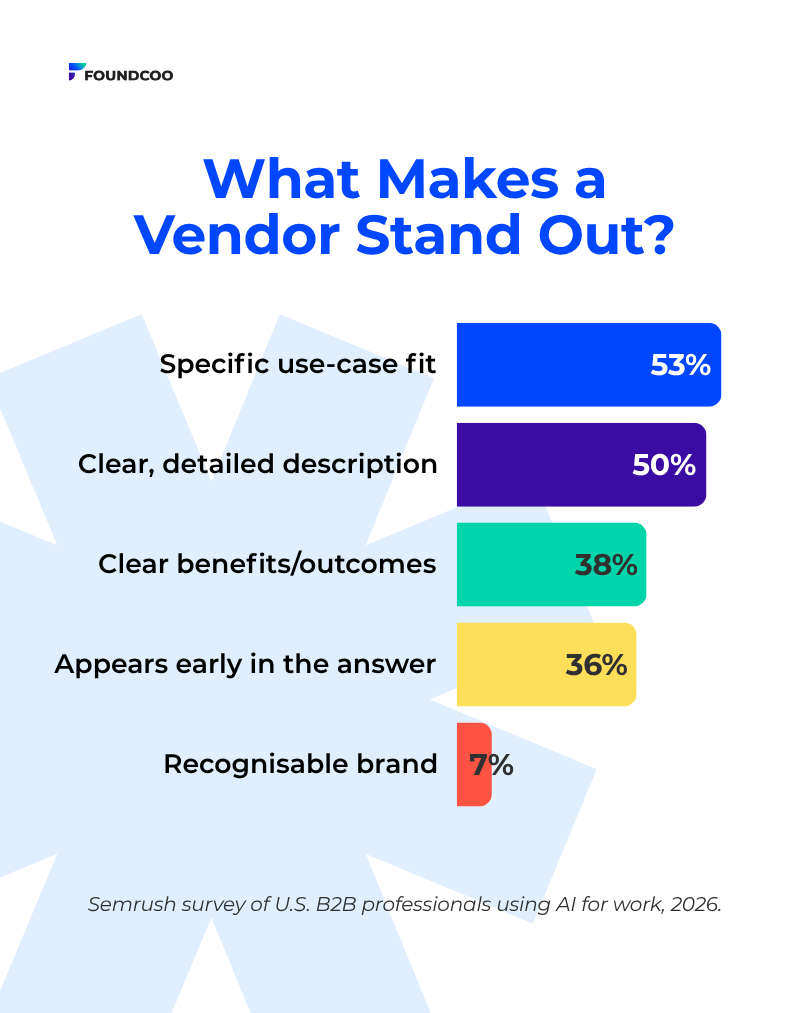
In Semrush's U.S. survey, when respondents saw a company mentioned in an AI response, 53% said they paid attention when it matched their specific use case and 50% when the description was clear and detailed. Only 7% cited recognising the brand name as the reason it caught their attention.
That does not mean brand strength is irrelevant. It means a well-known company is not automatically the most useful recommendation for every specific requirement.
For specialist B2B and industrial companies, this creates an opportunity. Instead of trying to become famous for everything, become extremely clear about the situations where you are particularly relevant.
For example:
Weak positioning
Industrial testing solutions for global customers.
Stronger positioning
High-force electrodynamic vibration testing systems for automotive, aerospace and electronics laboratories requiring sine, random and shock testing.
Or:
Weak positioning
Full-service digital marketing agency.
Stronger positioning
B2B and industrial marketing agency helping technical companies in Hong Kong, Singapore and APAC improve Google and AI-search visibility and generate qualified enquiries.
Specificity gives both buyers and AI systems more context.
5. Verification: The AI Recommendation Is Only the Beginning
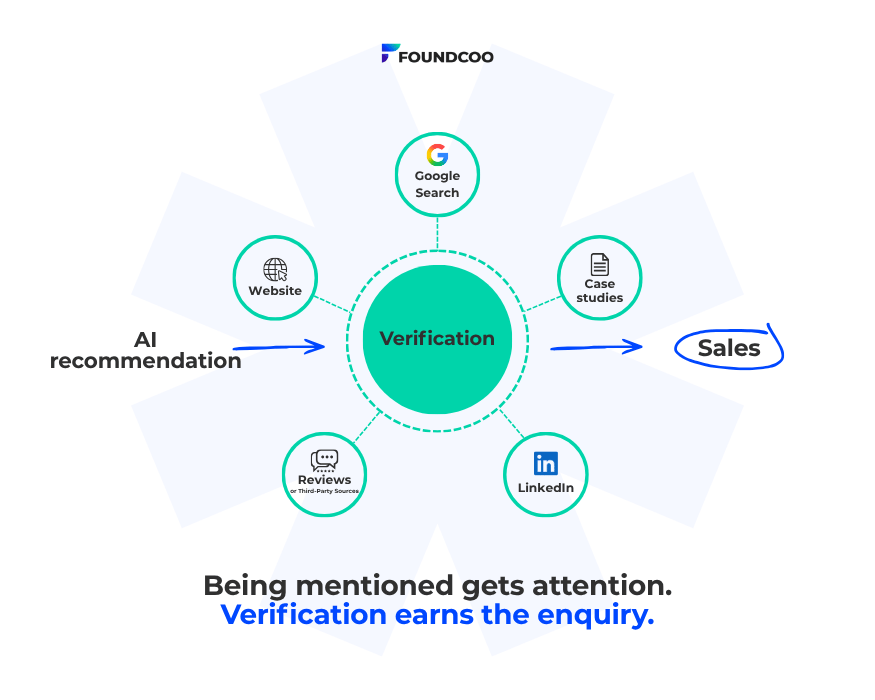
Being mentioned by AI does not mean the deal is won. It means the company has earned the right to be investigated.
Semrush found that after an AI system mentioned a vendor, 71% of respondents visited the vendor's website, 63% searched for the company on Google, 46% compared it with alternatives and 38% checked reviews on platforms such as G2.
Gartner provides another important signal. In a survey of 645 B2B buyers, respondents reported using an average of seven information sources during a recent purchase, while 69% said they preferred to validate AI-generated insights with sales representatives.
AI is therefore not replacing verification. It is changing what gets verified.
Imagine this journey
AI says: “Company A could be suitable because it specialises in industrial marketing in Asia.”
The buyer searches Company A.
They find:
An unclear website.
No relevant case studies.
An inactive LinkedIn page.
Inconsistent descriptions across directories.
No visible team expertise.
No third-party references.
Very little evidence of industrial work.
The AI recommendation has created interest. The company’s digital presence then destroys it.
What your business needs
Build a verification ecosystem:
Website
Provide detailed, credible and current information.
Case studies
Show:
The problem.
What was done.
Why that approach was chosen.
Technical or commercial complexity.
Results where they can be disclosed.
Foundcoo’s own B2B and industrial case-study library demonstrates how different projects can provide evidence around e-commerce infrastructure, industrial visibility, LinkedIn authority, web development and AI-SEO strategies.
Your company page and employees should reinforce—not contradict—the expertise presented on the website.
Foundcoo's B2B social media approach is built around using educational content, thought leadership, case studies and expertise to strengthen visibility and trust.
Third-party sources
Relevant sources may include:
Industry publications.
Associations.
Partner websites.
Conference pages.
Distributor websites.
Customer mentions.
Review platforms.
Specialist directories.
Podcasts.
Interviews.
Online communities.
We explore this further in Why Online Communities Now Shape Brand Visibility.
The objective is not to manufacture mentions. It is to build enough genuine digital evidence that your company survives scrutiny once someone starts checking.
6. Contact Decision: “Which Vendor Should I Speak To?”
Eventually, research must turn into action. And this is where many B2B websites introduce unnecessary friction. After spending 30 minutes researching your company, the buyer reaches a contact page that says: “Fill in the form and someone will get back to you.”
There is no explanation of:
Who will respond.
What happens next.
What information they should prepare.
Whether the consultation has a cost.
Whether the company works in their market.
Whether their project is too small or too complex.
At this point, clarity matters as much as visibility.
Improve the transition from research to sales
Tell buyers:
Who they will speak with.
What the first conversation covers.
How long it normally takes.
What information is useful beforehand.
Whether there is an assessment or consultation.
What kinds of companies you typically help.
What the logical next step will be.
AI visibility creates an opportunity.
Your conversion journey still needs to capture it.
The Foundcoo AI Vendor Shortlist Readiness Framework
Instead of asking: “Are we ranking in ChatGPT?” we recommend evaluating whether the digital presence contains the information required at every point in an AI-assisted buying journey.
Score your business from 0 to 2 against the following eight areas.
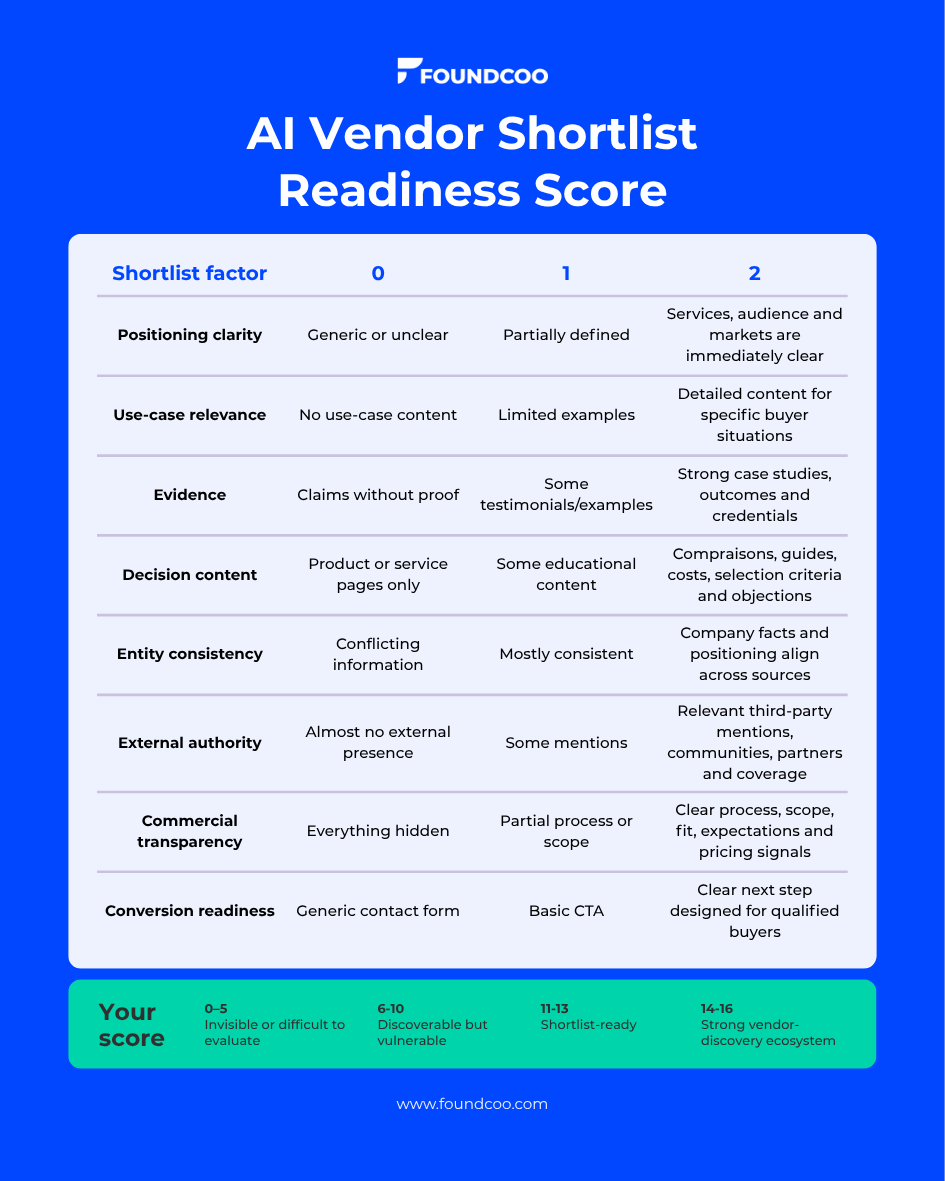
Your score
0–5: Invisible or difficult to evaluate
Your company may exist online, but there is not enough structured evidence to make vendor evaluation easy.
6–10: Discoverable but vulnerable
AI and buyers may find you, but competitors with clearer positioning or stronger proof can replace you during comparison.
11–13: Shortlist-ready
Your company provides enough relevant information to support serious evaluation across multiple buyer stages.
14–16: Strong vendor-discovery ecosystem
Your digital presence combines clarity, use-case relevance, evidence, external authority and conversion readiness.
A high score still does not guarantee recommendation by any AI platform. It means you have created a stronger information environment for both machine-assisted discovery and human evaluation.
What Content and Digital Assets Do You Need at Each Stage?
| Buyer stage | What the buyer wants | Content/assets you should provide |
|---|---|---|
| Problem discovery | Understand the issue | Explainers, troubleshooting, research, expert articles |
| Category exploration | Understand possible solutions | Guides, comparisons, technology explainers |
| Vendor discovery | Find suitable providers | Service, industry, application and location pages |
| Shortlist comparison | Decide who fits best | Comparison pages, selection criteria, pricing signals, case studies |
| Verification | Confirm credibility | Case studies, reviews, experts, LinkedIn, third-party mentions |
| Contact decision | Reduce purchase risk | Clear CTA, process, scope, expectations and next steps |
The point is not to create one page for every possible prompt. Build a connected information architecture where each important buyer question has a credible place to be answered.
That is also good traditional SEO and AI-search optimisation. Foundcoo's current SEO approach combines technical SEO, buyer-intent research, content strategy, AEO and GEO rather than treating conventional and AI search as separate disciplines.
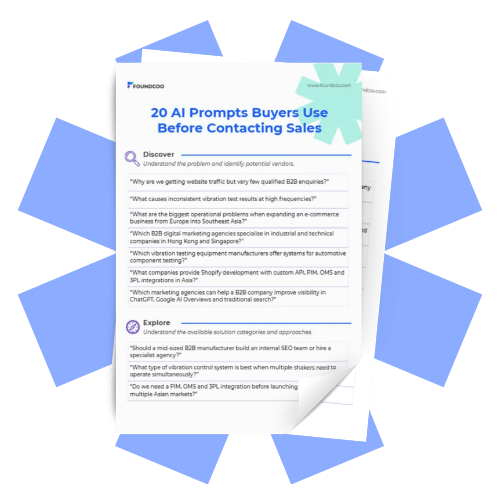
20 AI Prompts B2B Buyers May Use When Choosing a Vendor
The following examples show why B2B AI-search strategy needs to cover far more than “[service] + company.”
Problem Discovery
1. “Why are we getting website traffic but very few qualified B2B enquiries?”
2. “What causes inconsistent vibration test results at high frequencies?”
3. “What are the biggest operational problems when expanding an e-commerce business from Europe into Southeast Asia?”
Category Exploration
4. “Should a mid-sized B2B manufacturer build an internal SEO team or hire a specialist agency?”
5. “What type of vibration control system is best when multiple shakers need to operate simultaneously?”
6. “Do we need a PIM, OMS and 3PL integration before launching ecommerce in multiple Asian markets?”
Vendor Discovery
7. “Which B2B digital marketing agencies specialise in industrial and technical companies in Hong Kong and Singapore?”
8. “Which vibration testing equipment manufacturers offer systems for automotive component testing?”
9. “What companies provide Shopify development with custom API, PIM, OMS and 3PL integrations in Asia?”
10. “Which marketing agencies can help a B2B company improve visibility in ChatGPT, Google AI Overviews and traditional search?”
Shortlist Comparison
11. “Compare three B2B marketing agencies in Singapore for an industrial company selling internationally.”
12. “Compare these vibration testing suppliers based on force rating, controller compatibility, local support and customisation.”
13. “Which e- commerce development agency is more suitable for a European brand entering Hong Kong, Singapore and South Korea?”
14. “Compare these marketing intelligence platforms based on SEO, competitor analysis, social data, ease of use and cost.”
Constraint-Based Evaluation
15. “Which agency is suitable for a B2B company with a small internal marketing team and a long technical sales cycle?”
16. “Which supplier can support this application if we need local commissioning, custom fixtures and future system expansion?”
17. “Which e-commerce platform and development partner should we choose if we need multilingual stores, regional inventory and external 3PL partners?”
Verification and Decision
18. “What evidence shows that this company has worked with industrial or engineering businesses before?”
19. “What are the main strengths and weaknesses of these three suppliers?”
20. “What should I ask these vendors during the first sales meeting before deciding which one to shortlist?”
These prompts demonstrate an important difference between keywords and AI-assisted research.
The buyer is often providing:
Context.
Industry.
Geography.
Problem.
Constraints.
Budget.
Technology.
Desired outcome.
Your content needs enough depth to remain relevant when those variables are added.
Download: 20 AI Prompts B2B Buyers Use Before Contacting Sales
How Do You Get Recommended by ChatGPT and Other AI Tools?
There is no guaranteed method for getting a company recommended by ChatGPT—or any other major AI platform. Be cautious of anyone promising one. A more useful objective is to increase the probability that your company can be discovered, correctly understood and credibly evaluated when AI systems and buyers research your category.
Focus on these areas.
1. Make Your Positioning Explicit
Do not make readers infer what you do.
Clearly state:
Company category.
Core services.
Industries.
Markets.
Use cases.
Technologies.
Specialisms.
2. Build Content Around Use Cases, Not Only Keywords
Instead of only targeting: “vibration testing equipment”
also address:
“vibration testing equipment for EV battery testing.”
Instead of only: “B2B SEO agency”
also address:
“B2B SEO for industrial companies with long sales cycles.”
Specificity improves relevance.
3. Publish Decision-Stage Content
Many companies publish awareness content but almost nothing that helps someone choose.
Create:
Buyer guides.
Comparisons.
Cost guides.
Selection checklists.
Integration guides.
Technical requirement pages.
“When not to use” articles.
Implementation explanations.
The closer a buyer gets to making a decision, the more specific the questions become.
4. Support Claims With Evidence
Replace: “We are a leading provider.”
with evidence.
Show:
Customer examples.
Projects.
Outcomes.
Certifications.
Years of relevant experience.
Markets served.
Technical capabilities.
Named methodologies.
Expert credentials.
Foundcoo's case studies are one example of turning service claims into project-level evidence.
5. Build Authority Outside Your Website
Your own website will naturally say positive things about your business. Independent validation provides a different type of evidence.
Develop meaningful visibility through:
Relevant publications.
Industry organisations.
Partners.
Distributors.
Conferences.
Customers.
Expert interviews.
Professional communities.
Review platforms.
Do not build fake mentions purely to manipulate AI results.
Build genuine authority that would matter even if AI search did not exist.
6. Keep Company Information Consistent
Check how your company is described on:
Website.
LinkedIn.
Google Business Profile.
Partner websites.
Industry directories.
Review platforms.
Employee profiles.
Press coverage.
If one page describes you as an IT consultancy, another as an e-commerce agency and another as a general advertising firm, the entity becomes unnecessarily difficult to interpret.
7. Keep Important Information Current
Outdated pricing, obsolete products, former markets or old service descriptions create problems for both buyers and systems retrieving information from the web.
Review key commercial pages regularly.
8. Build a Technically Strong Website
AI visibility does not eliminate SEO fundamentals.
A website should still be:
Crawlable.
Indexable.
Fast.
Mobile-friendly.
Logically structured.
Internally linked.
Accessible.
Clear about canonical pages.
Our guide to adapting SEO for Google AI Overviews and AI Mode explores the relationship between traditional SEO, AEO and deeper AI-search content strategy.
The Biggest Mistake: Optimising Only for AI
AI is not the buyer. The buyer still needs to trust your company. This distinction becomes clear when we look at what happens after an AI recommendation.
A prospect may:
Discover you through ChatGPT or any other AI platform.
Search your company on Google.
Visit your website.
Check your team on LinkedIn.
Read a case study.
Look for customer evidence.
Ask AI another question comparing you with a competitor.
Send your website to another stakeholder.
Contact sales.
That is not an “AI channel.” It is a connected research journey. This is why AI-search optimisation should not become an isolated marketing tactic. Search, LinkedIn, content, digital PR, website experience, case studies, analytics and sales conversion all contribute to the final decision.
What This Means for B2B Companies in Asia
The Semrush research discussed in this article surveyed U.S. professionals, so the percentages should not be presented as Asian buyer statistics.
However, there are important implications for companies selling across Hong Kong, Singapore and wider APAC markets.
Cross-border B2B purchases often introduce additional evaluation criteria.
A buyer may ask:
Does this supplier serve Singapore?
Does it have a distributor in Thailand?
Can it provide technical support in China?
Has it worked with European standards?
Does it support multilingual e-commerce?
Can it integrate with regional marketplaces?
Can it ship and commission equipment locally?
Does it understand Asian procurement requirements?
Can it support several countries from one contract?
If these capabilities matter commercially, make them explicit online. Do not assume buyers—or AI systems—will infer regional capabilities from a small office address hidden in the footer.
Foundcoo itself clearly positions its work around B2B and industrial companies across Hong Kong, Singapore, APAC and global markets.
For companies operating across Asia, geographical relevance should become part of the content architecture, not merely part of the About page.
How Should B2B Companies Measure AI Vendor Visibility?
Do not rely on one prompt. Because AI responses can vary, measure clusters of commercially relevant questions.
At Foundcoo, a useful assessment will examine:
Prompt coverage
Does the company appear across:
Problem prompts?
Category prompts?
Vendor prompts?
Comparison prompts?
Geographic prompts?
Use-case prompts?
Frequency
How regularly does the company appear across repeated tests?
Context
Is the company presented as:
An expert source?
A possible supplier?
A recommended vendor?
An alternative?
A market example?
Accuracy
Is the description correct?
Does AI understand:
What you sell?
Where you operate?
Who you serve?
What differentiates you?
Competitive presence
Which competitors appear more frequently?
More importantly: Why do they have stronger supporting information?
Verification strength
Once your company is surfaced, does the rest of your digital presence support the recommendation?
Commercial outcomes
Over time, monitor signals such as:
Branded search growth.
Direct traffic.
Relevant service-page traffic.
Returning visitors.
Enquiry quality.
“How did you hear about us?” responses.
Qualified opportunities.
Pipeline.
AI visibility should ultimately connect back to business performance.
Where Claryx Fits
AI vendor visibility cannot be understood by examining AI prompts alone. You also need to know what competitors are doing, where your website is weak, which content gaps exist and whether your wider digital authority is improving.
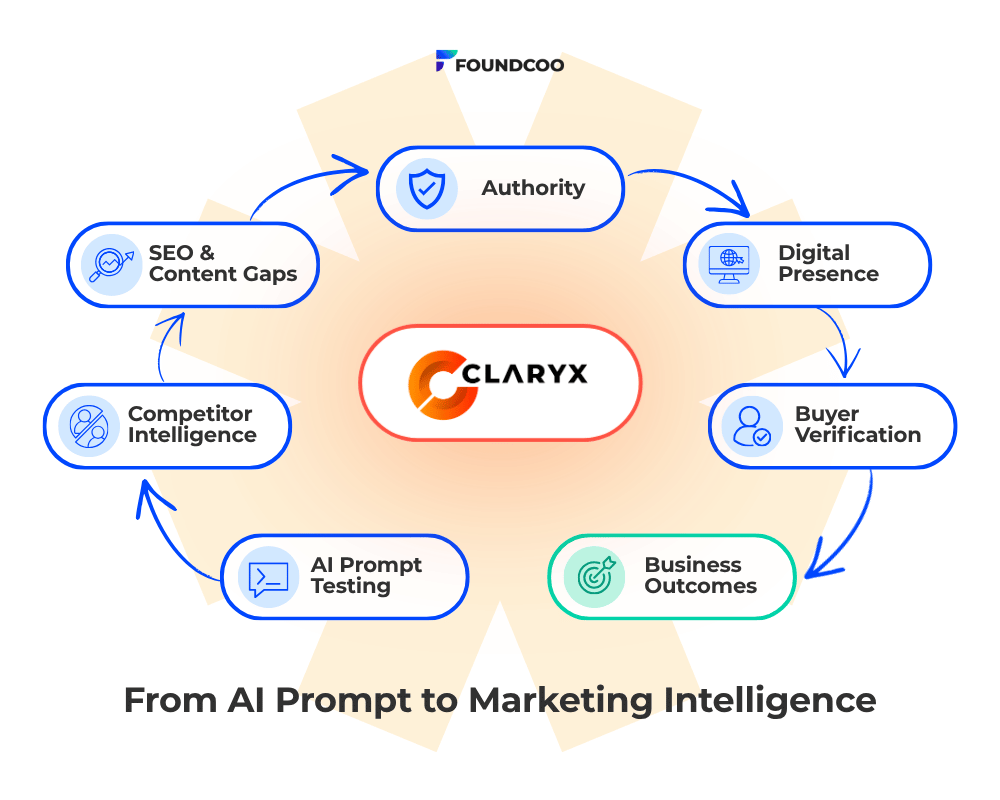
Claryx, Foundcoo's AI marketing intelligence platform, brings together website and SEO performance, competitor intelligence, backlink analysis, social media performance and AI-driven recommendations designed to help teams understand what needs attention next.
For vendor-discovery strategy, this helps answer surrounding questions such as:
Which competitors have stronger search visibility?
Where are their backlinks coming from?
Which pages and topics are they investing in?
How does their website performance compare with ours?
Which content gaps should we prioritise?
Is their digital authority growing faster?
Which social content is generating visibility?
Claryx’s value is in helping businesses understand and improve the digital ecosystem that supports discoverability, authority and competitive positioning. That intelligence can then be combined with AI prompt testing and Foundcoo's wider visibility strategy.
Common Questions About AI-Generated B2B Vendor Shortlists
-
There is no single published formula that applies across all AI platforms. Recommendations can depend on the specific question, available information, web sources, context, location, use case and platform. The practical objective is to make your company easier to discover, understand and verify across relevant sources.
-
There is no guaranteed technique. Build clear service and use-case content, maintain accurate company information, publish useful decision-stage resources, develop credible third-party authority and ensure your website is technically accessible. When ChatGPT uses web search, it can retrieve current web information and provide linked sources.
-
No. Traditional search visibility remains valuable, but AI-generated answers can synthesise information differently depending on the question and context. A strong Google ranking does not create a guaranteed AI recommendation.
-
Potentially, yes. In Semrush's U.S. research, specific use-case fit and clear descriptions were far more commonly cited as reasons buyers noticed a vendor than simple brand recognition.
-
Case studies provide clear evidence of experience, applications, industries and outcomes. They also help human buyers verify the claims they encounter during AI-assisted research. Their value extends beyond AI because they reduce uncertainty during vendor evaluation.
-
No. Create comprehensive topic clusters around genuine buyer problems, use cases and decision questions. Hundreds of thin pages targeting minor prompt variations can create poor user experience and content duplication.
-
They can strengthen discoverability and verification by providing independent context about a company. Focus on relevant, genuine sources rather than creating artificial mentions solely for AI optimisation.
-
Identify whether the inaccurate information exists on your own website or elsewhere online. Correct outdated pages, company profiles, partner listings and other authoritative sources. Consistency across the digital ecosystem reduces opportunities for contradictory information.
The New B2B Question Is Not “Where Do We Rank?”
For years, companies competed for position on a search-results page. That competition still matters. But B2B discovery is expanding into something different.
A potential customer can now ask:
“Explain my problem.”
Then:
“What solutions exist?”
Then:
“Which companies provide them?”
Then:
“Compare the best three for my requirements.”
Then:
“What are the weaknesses of each?”
Then:
“Which questions should I ask before making a decision?”
All of that can happen before your sales team knows the buyer exists. This changes what digital authority means.
The businesses most prepared for this environment will not simply publish the most content or mention “AI SEO” most frequently.
They will make themselves easy to understand, relevant to specific problems, supported by evidence and credible wherever a buyer chooses to verify them.
The objective is no longer only to rank. It is to become difficult to exclude from the conversation.
Is Your Company Appearing in the AI-Generated Shortlist?
Foundcoo helps B2B and industrial companies understand how they are discovered across traditional search, AI-assisted research and the wider digital ecosystem.
Our approach combines:
Traditional SEO.
AEO and GEO.
AI vendor-discovery analysis.
Content strategy.
Competitor intelligence.
Technical SEO.
Digital authority.
LinkedIn visibility.
Case-study development.
Conversion optimisation.
Marketing intelligence through Claryx.
We look beyond a one-off ChatGPT prompt to understand where your company appears, how it is described, which competitors are being surfaced instead and what digital evidence may be missing.
Is your company appearing in the AI-generated shortlist? Request an AI visibility and vendor-discovery assessment and discover what buyers—and the AI tools helping them—can actually find about your business.