

Small businesses aren't exactly starving for marketing data. If anything, they're drowning in it.
You have Google Analytics for your website, Search Console for your organic reach, and separate native analytics for LinkedIn, Facebook, and Instagram. Then there are your SEO tools tracking keywords, your email platform reporting on campaigns, and your competitor research living off in its own silo.
It’s a familiar headache: more dashboards and more numbers, but not necessarily better decisions.
This is where AI-powered marketing intelligence platforms come in. But it’s important to draw a distinction. Just because a tool can generate marketing copy or send emails using AI doesn't make it a marketing intelligence platform.
Real marketing intelligence is about gathering and making sense of data so you actually understand:
What’s happening
Why it’s happening
How you stack up against competitors
Where your opportunities and risks are
What you should actually do next
If you're running a small business or a lean marketing team, this distinction is everything. You simply don't have the time or budget to juggle five different enterprise tools just to figure out your next move.
So, what are the best AI-powered marketing intelligence platforms for small businesses? The answer really depends on the specific problem you're trying to solve.
Quick Answer: Which AI Marketing Platform Is Best for What?
| Platform | Best suited for | Main strength | Main limitation for marketing intelligence |
|---|---|---|---|
| Claryx | Small businesses and lean B2B marketing teams needing one intelligence view | SEO, website, competitors, social and AI recommendations together | Younger platform with a smaller ecosystem than established enterprise tools |
| HubSpot | Businesses already managing marketing and sales through a CRM | CRM-connected marketing, automation, attribution and AI | Can be broader and more complex than a small team needs |
| MarketMuse | Businesses focused heavily on SEO content strategy | Content intelligence, topical authority and planning | Primarily content-focused rather than full cross-channel intelligence |
| Brevo | Small businesses focused on email, CRM and automation | Affordable campaign automation and customer engagement intelligence | Less focused on SEO, competitor and broader market intelligence |
| Jasper | Marketing teams scaling AI-assisted content and brand execution | Brand-governed content, workflows and AI-search execution | Primarily execution/content oriented rather than a unified SMB analytics platform |
| Canva | Small teams needing AI-powered visual content production | Creative production, collaboration and brand consistency | Creative platform rather than a dedicated marketing intelligence system |
| Semrush | Businesses requiring deep SEO and competitive research | SEO, competitor analysis and AI-search visibility | Powerful but broader, more specialised and potentially more complex for lean teams |
There isn't a one-size-fits-all platform for every small business. Instead of looking for the "best" one, it's more helpful to ask: which platform actually solves the specific marketing challenges your team is facing right now?
Table of Contents
Claryx: Best for Unified Marketing Intelligence Without Enterprise Complexity
HubSpot: Best When Marketing Intelligence Must Connect to CRM
Marketing Intelligence vs AI Marketing Tools: Know What You Are Buying
What Should a Small Business Look for in Marketing Intelligence Software?
Common Questions About AI Marketing Intelligence for Small Businesses
The Best Marketing Intelligence Platform Is the One You Will Act On
What Is an AI-Powered Marketing Intelligence Platform?
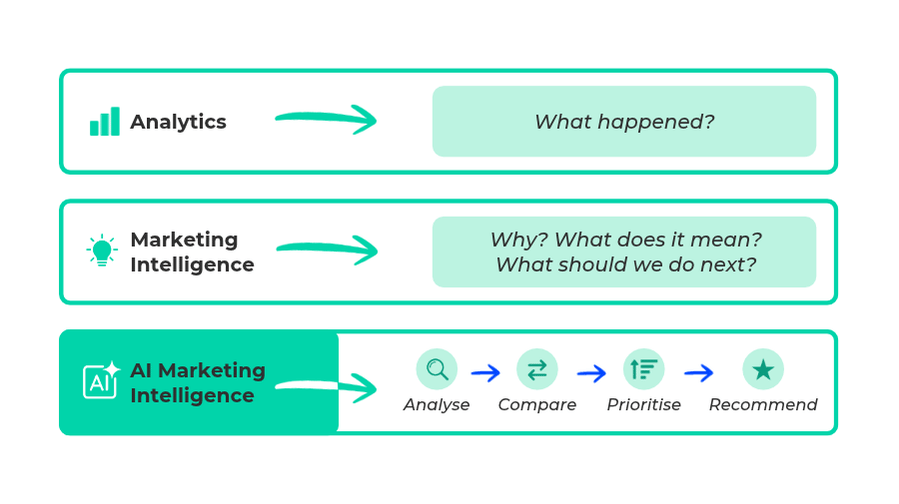
Think of an AI-powered marketing intelligence platform as your data-savvy teammate. It pulls together your marketing stats, keeps an eye on the competition, and watches market signals, using AI to spot patterns and help you make smarter decisions.
While traditional analytics just tells you what happened, marketing intelligence goes a step further. It answers the real questions: Why does this matter? How do we stack up? And what’s our next move?
For small businesses, a great platform should actually cut down on your analysis time—not add to it. That means it needs to help with a few key jobs:
Data consolidation: Bringing all your marketing info together in one spot.
Performance interpretation: Highlighting what’s working, what’s slipping, and what looks a little unusual.
Competitor intelligence: Showing you where others are leading and where you can find your edge.
Opportunity identification: Spotting practical ways to boost your results.
Prioritisation: Helping your team figure out what to tackle first.
Plain-language recommendations: Turning raw data into clear next steps, no data analyst required.
This really sets true marketing-intelligence tools apart from the generic "best AI marketing tools" you see on most lists.
1. Claryx: Best for Unified Marketing Intelligence Without Enterprise Complexity
Claryx is Foundcoo's own AI marketing intelligence platform, so we want to be transparent about the relationship from the start.
We built it because we kept running into the same wall with our B2B clients: the data was everywhere, but the answers were nowhere.
Your website traffic lived in one tab, search rankings in another, and social metrics somewhere else entirely. Tying it all together—let alone figuring out what to actually do next—was a full-time job.
That is the problem Claryx is designed to solve.
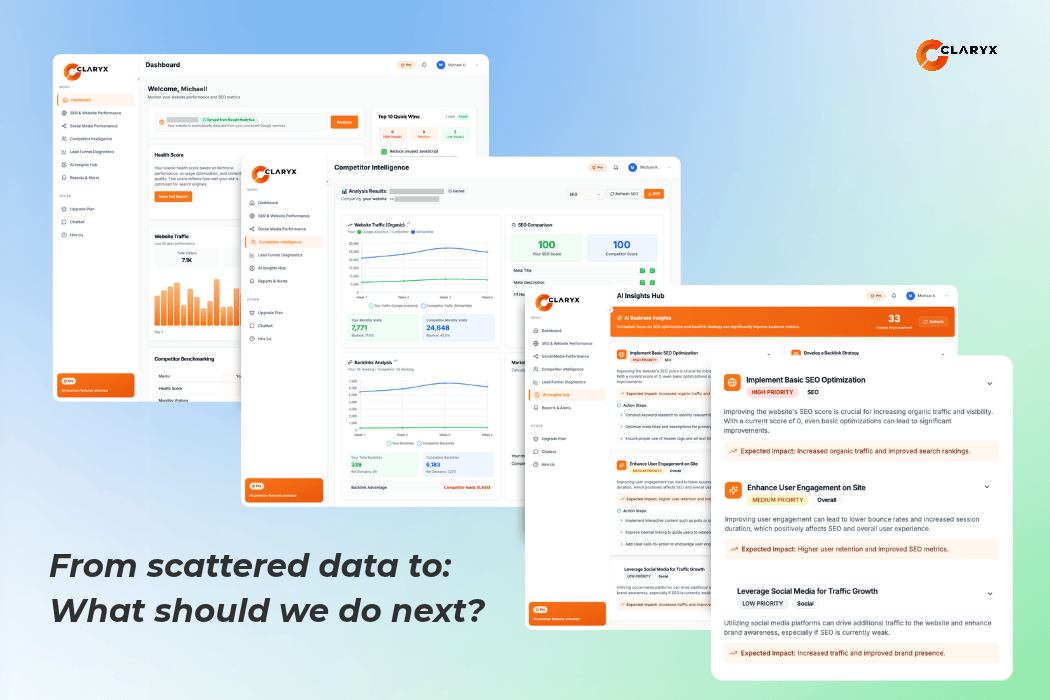
The platform combines marketing and competitor information and turns it into prioritised actions instead of leaving the user to interpret another collection of dashboards.
You can explore the platform directly through the Claryx website.
What Claryx Covers
Claryx currently brings together several areas that small marketing teams often manage separately:
SEO and Website Performance
Teams can review:
Website traffic and engagement.
Search visibility.
Keywords and search queries.
Technical SEO.
Core Web Vitals.
Content performance.
Backlinks on relevant plans.
Potential optimisation opportunities.
Competitor Intelligence
Claryx can compare your digital presence against selected competitors across areas including:
Organic visibility.
SEO.
Website performance.
Technical setup.
Content.
Backlinks.
Social performance.
The objective is not simply to show that a competitor performs better.
It is to help answer: Where exactly are they ahead, and what should we do about it?
Claryx's competitor-intelligence functionality is documented in more detail in its help centre.
Explore Claryx Competitor Intelligence →
Social Media Intelligence
Claryx brings social performance into the wider marketing picture rather than treating social media as an isolated channel.
Depending on the plan, teams can analyse platforms including LinkedIn, Facebook and Instagram and compare engagement patterns, audience growth and content performance.
AI Insights Hub
This is where the intelligence layer becomes important.
Instead of simply presenting the data, Claryx analyses connected information and generates recommendations with:
Priority.
Estimated effort.
Expected impact.
Suggested timeframe.
The AI Insights Hub can identify opportunities across SEO, social performance, backlinks and competitor gaps.
AI Chat Assistant
On the Pro plan, users can ask questions about their marketing data in plain language.
For example:
“What should I prioritise this month?”
“Where are competitors outperforming us?”
“What are our biggest growth opportunities?”
That removes another layer of analysis for businesses that do not have a dedicated marketing-data specialist.
Is Claryx Suitable for Small Businesses?
This is one of the reasons we built the platform.
Large companies can hire:
SEO specialists.
Data analysts.
Social-media teams.
Competitive-intelligence specialists.
Performance marketers.
Marketing-operations teams.
A small business may have one marketing manager—or a founder trying to understand everything between meetings.
The tool therefore has to answer a fundamentally different question:
How much useful intelligence can we provide without adding another full-time job?
Claryx currently starts at $23 per month, while Growth and Pro plans add deeper competitor intelligence, backlink analysis, AI recommendations, LinkedIn analysis and the AI Chat Assistant. A seven-day Pro trial is available without a credit card.
See Claryx pricing and plan comparison →
Independent software directories is also categorising the platform around this use case. GetApp describes Claryx as an AI-powered marketing intelligence platform that turns scattered data into a prioritised action list, while Software Advice describes it as being built for lean teams and small and midsized B2B companies without dedicated analytics resources.
Best fit
Claryx makes the most sense when your problem sounds like this:
“We already have marketing data. We need one place to understand it, compare ourselves with competitors and know what to do next.”
Less suitable when
Claryx is not intended to replace every specialised marketing platform.
If you require enterprise CRM infrastructure, HubSpot or Salesforce may be more appropriate.
If your entire problem is content optimisation, MarketMuse may provide greater depth in that specific area.
If your goal is primarily creating visual assets, Canva addresses a different need.
And if you need an extensive specialist SEO toolkit, a platform such as Semrush may offer functionality beyond what a lean team actually requires.
That is why comparing AI marketing platforms by job-to-be-done is more useful than trying to declare one tool universally best.
2. HubSpot: Best When Marketing Intelligence Must Connect to CRM
HubSpot appears frequently in AI marketing-tool recommendations for a good reason: it has built a broad ecosystem around CRM, marketing, sales, customer service, analytics and increasingly AI.
Its current Marketing Studio uses business context and campaign-performance data to identify opportunities, recommend actions, create campaigns and connect activity with revenue. HubSpot's Breeze AI is integrated throughout its customer platform.
Explore HubSpot’s AI platform →
For a small business already using HubSpot as its CRM, this integration can be a significant advantage.
Customer information, marketing activity and sales outcomes already live in the same ecosystem.
Best fit
Choose HubSpot when your main priority is:
Marketing + CRM + automation + sales intelligence in one customer platform.
Where the trade-off appears
HubSpot solves many more problems than marketing intelligence alone.
For a growing business that needs that infrastructure, this breadth can be valuable.
For a small team primarily trying to understand SEO, social performance, competitors and next marketing priorities, however, a full CRM-centric ecosystem may be more platform than necessary.
This illustrates one of the most important rules when choosing AI software:
More functionality does not automatically mean better fit.
3. MarketMuse: Best for AI-Powered Content Intelligence
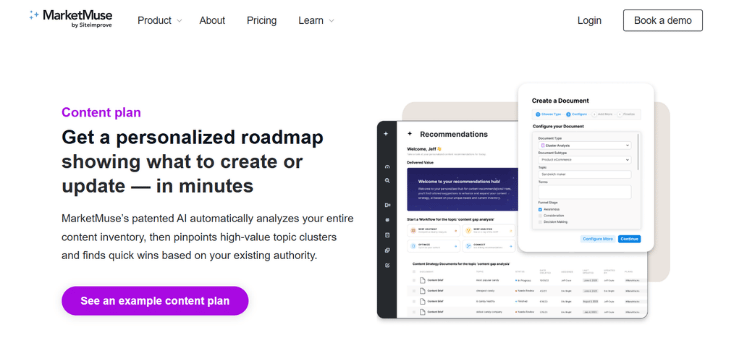
MarketMuse is much closer to the traditional definition of content intelligence.
Its focus is helping teams understand:
Topic coverage.
Content gaps.
Topical authority.
Content opportunities.
Which pages should be created or improved.
Where a website has a realistic competitive advantage.
Its current pricing structure includes plans ranging from individual use through larger content teams and agencies.
MarketMuse has also spent years building content around AI, content strategy and marketing intelligence, which has helped establish a strong association between its brand and the category. Its AI-marketing archive includes material on content automation, ChatGPT, content analysis and the broader role of AI in marketing.
Best fit
MarketMuse is particularly suitable when your core question is:
“What content should we create or improve to build search authority?”
Where the trade-off appears
Content is only one part of the marketing picture.
If you also need social-media intelligence, broader website-performance monitoring or ongoing competitor benchmarking across multiple channels, you may require additional platforms.
4. Brevo: Best for Affordable AI-Powered Email and Automation
Brevo is a strong example of why the term “AI marketing platform” can become confusing.
Brevo is not primarily a marketing-intelligence platform.
Its core strength is customer communication and marketing automation across areas including email, SMS, WhatsApp, forms and automated journeys.
However, AI and analytics increasingly sit inside that workflow.
Brevo currently offers:
AI-generated marketing content.
Audience segmentation.
Send-time optimisation.
Campaign analytics.
Web and event tracking.
ROI and conversion reporting.
An AI data analyst on relevant offerings.
Explore Brevo’s AI capabilities →
Its pricing and packaging are also explicitly built around individuals, solopreneurs and small businesses, which helps explain why it appears frequently in small-business AI-tool recommendations.
Best fit
Brevo makes sense when your primary problem is:
“How can we automate and improve email and customer communication without an enterprise marketing stack?”
Where the trade-off appears
Brevo will not replace a platform dedicated to broader competitor intelligence, SEO visibility or multi-channel marketing analysis.
It solves a different job extremely well.
5. Jasper: Best for AI-Powered Marketing Content and Execution
Jasper originally became known primarily for AI-generated content.
The platform has evolved considerably.
Its current positioning focuses on marketing execution, content pipelines, AI agents, brand governance and increasingly AI-search visibility. Jasper also offers GEO and AI Discovery functionality aimed at helping companies measure and improve how their brands appear across AI answer engines.
Explore the Jasper marketing platform →
One of Jasper's biggest advantages is its content ecosystem.
The company does not simply sell an AI product.
It publishes:
Original research.
Annual AI-marketing reports.
AI-maturity frameworks.
Product education.
GEO and AEO resources.
Workflow guides.
Marketing-operations insights.
Its 2026 State of AI in Marketing research surveyed 1,400 marketers, giving the company proprietary data that other publications can reference.
Best fit
Jasper is a strong option when the main challenge is:
“How do we create and execute more marketing content with AI while keeping it consistent with our brand?”
Where the trade-off appears
Its centre of gravity remains marketing execution and content rather than a simplified cross-channel analytics and competitor-intelligence dashboard for small companies.
Current Jasper Pro pricing starts at $59 per month when billed annually, with Business pricing customised.
6. Canva: Best for AI-Powered Creative Marketing
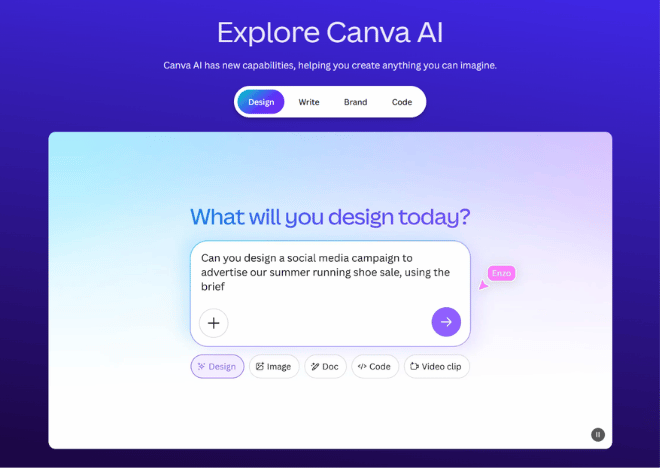
Canva appears in many AI-marketing recommendations even though it would be misleading to describe it as a dedicated marketing-intelligence platform.
Its strength is creative execution.
Canva helps small businesses produce:
Social-media graphics.
Presentations.
Advertising assets.
Videos.
Marketing collateral.
Branded templates.
AI-assisted creative content.
The platform has also built a significant educational ecosystem around AI marketing, including its own AI-marketing guides and the State of Marketing & AI 2026 research.
Explore Canva’s AI marketing guide →
This is important because it illustrates another reason brands become strongly associated with a topic:
They do not only build products around the category. They publish useful information about the category repeatedly.
Best fit
Canva is a strong choice when your small team needs:
Fast, accessible and increasingly AI-assisted visual marketing production.
Where the trade-off appears
Canva does not replace marketing intelligence across SEO, competitor visibility and website performance.
It belongs in the marketing stack, but it solves a different problem.
7. Semrush: Best for Deep SEO and Competitive Intelligence
Semrush belongs in this comparison because it is much closer to the marketing-intelligence category than some general AI marketing tools.
Semrush provides extensive capabilities across:
SEO.
Keywords.
Competitor analysis.
Backlinks.
Traffic intelligence.
Content.
Paid-search research.
AI-search visibility.
Current independent comparisons continue to position it strongly for SEO, competitive intelligence and AI-search visibility.
For companies where organic search and competitive research are central to growth, Semrush can provide substantial depth.
Best fit
Semrush is particularly useful when your question is:
“How can we deeply analyse search visibility, competitors, backlinks and online market performance?”
Where the trade-off appears
That depth also means more functionality to learn and manage.
For a specialist SEO team, that may be exactly what is required.
For a small business owner or lean marketer who primarily wants clear priorities rather than another sophisticated research environment, simplicity may carry greater value.
Marketing Intelligence vs AI Marketing Tools: Know What You Are Buying
This distinction can save a small business hundreds—or thousands—of dollars in unnecessary subscriptions.
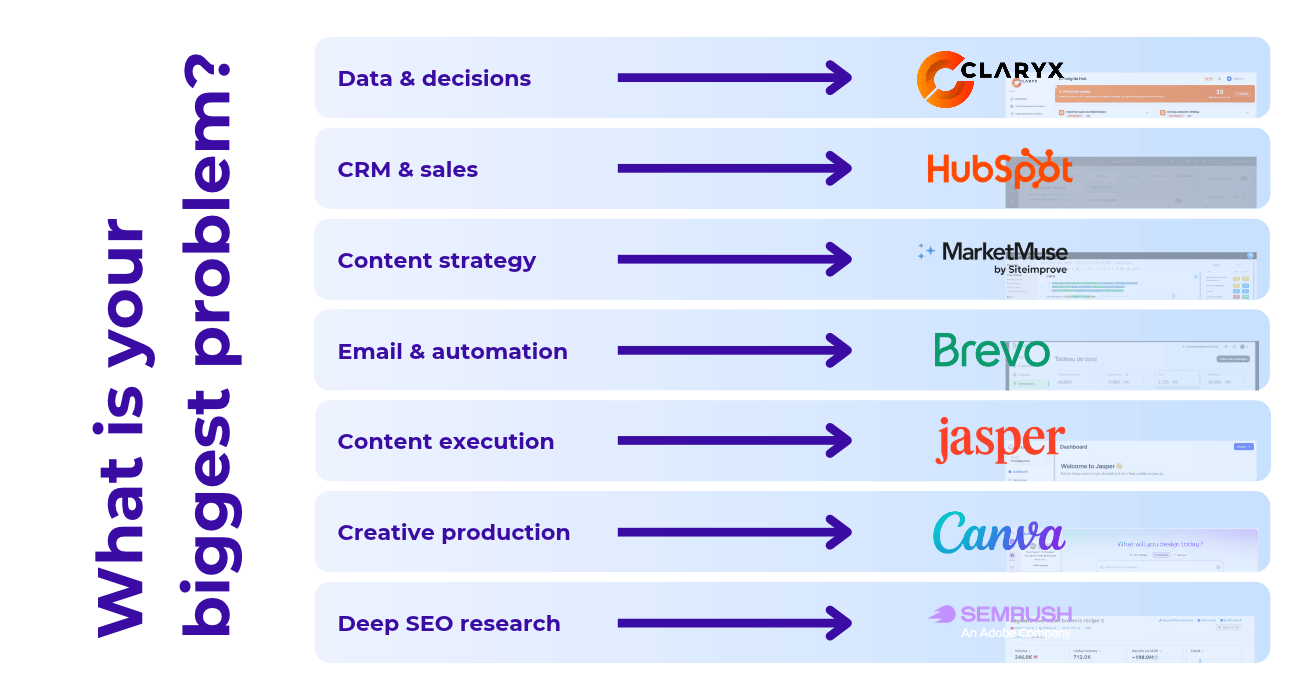
Consider these six marketing jobs:
| Your main problem | Tool category to look for |
|---|---|
| “We don't know what our marketing data means or what to prioritise.” | Marketing intelligence |
| “We need one system for customers, leads and sales.” | CRM / customer platform |
| “We need to produce content faster.” | AI content platform |
| “We need better SEO content planning.” | Content intelligence |
| “We need automated email and nurturing.” | Marketing automation |
| “We need visual content quickly.” | Creative AI platform |
This is why asking for the “best AI marketing tool” often produces an unhelpful answer.
The category is too broad.
A better question is:
What marketing decision or workflow is currently costing our team the most time, money or missed opportunity?
Then choose the platform that solves that problem first.
What Should a Small Business Look for in Marketing Intelligence Software?
For a small business, enterprise capability is not automatically an advantage.
The platform needs to earn its place in the stack.
We recommend evaluating any marketing-intelligence tool against seven practical criteria.
1. Does It Connect to the Data You Already Use?
Start with the basics.
If your business depends on Google Search Console, website analytics, LinkedIn or Meta, confirm that the platform can meaningfully work with those sources.
Do not redesign your entire marketing stack just to accommodate an intelligence tool.
2. Does It Explain the Data or Only Display It?
Another dashboard is not necessarily intelligence.
Ask:
When something changes, will the platform help me understand why it matters?
Small teams benefit most when software moves from:
Metric → Interpretation → Recommended action
rather than stopping at the metric.
3. Does It Include Competitor Context?
Knowing that your organic traffic grew by 8% sounds positive.
But what if your three closest competitors grew by 40%?
Performance without context can be misleading.
Competitive intelligence helps answer:
Are we gaining or losing ground?
Which topics are competitors winning?
Are they building authority faster?
Is their website technically stronger?
Which content is generating attention?
Where are obvious gaps?
This is one reason competitor intelligence is a core part of Claryx rather than a separate add-on conceptually.
4. Can a Non-Specialist Understand It?
Small businesses frequently do not have a data analyst sitting next to the marketing manager.
Software should therefore communicate in plain language.
If every recommendation still needs to be decoded by an SEO specialist, analyst and developer before anyone can act, the platform has only moved the complexity somewhere else.
5. Does It Prioritise?
Ten problems are not ten priorities.
A useful intelligence system should help distinguish:
Urgent from non-urgent.
High-impact from low-impact.
Quick wins from long-term projects.
Symptoms from underlying problems.
Claryx's AI Insights Hub, for example, categorises recommendations by factors including priority, effort, expected impact and timeframe.
6. Is Pricing Predictable?
A $20 product can become expensive when the business needs:
Five additional seats.
More contacts.
Extra reports.
AI credits.
Competitor tracking.
API access.
Additional data connectors.
Evaluate the real configuration you need, not only the advertised entry price.
7. Can You Test It With Your Own Data?
A polished demo can make almost any analytics platform look useful.
The real question is whether it improves decisions with your own marketing data.
Use free plans or trials to test realistic situations.
For example:
“What is our biggest SEO weakness?”
“Which competitor is gaining visibility fastest?”
“Which content should we improve?”
“Where should our small team focus next month?”
If the platform cannot make those answers clearer, it may not solve the problem you actually have.
Which Platform Is Best for a Small B2B Marketing Team?
For a small B2B company, the challenge is often different from a small e-commerce retailer or local consumer business.
B2B teams frequently manage:
Longer sales cycles.
Smaller numbers of higher-value leads.
Technical content.
LinkedIn.
Search visibility.
Competitor positioning.
Multiple decision-makers.
Complex services.
Limited internal marketing resources.
That means the value of marketing intelligence comes less from producing another dashboard and more from finding which actions are most likely to strengthen qualified visibility and pipeline.
That is the environment Claryx was originally built for.
Foundcoo first developed the platform to support its own work with B2B and industrial clients before making it available as a standalone product.
Read how Foundcoo built Claryx →
If your team is dealing with scattered SEO, website, social and competitor data, this narrower focus may be more useful than adopting an enterprise platform with dozens of modules you will rarely open.
How AI Changes Marketing Intelligence
The most important shift is not that AI can generate another chart. It is that marketing software can increasingly help interpret what the chart means.
For years, the analytics workflow looked like this:
Collect → Export → Report → Interpret → Discuss → Decide → Act
AI can shorten that chain.
A stronger model is:
Collect → Analyse → Prioritise → Act
Human judgement still matters. AI does not know your commercial context perfectly. It does not attend sales calls. It may not know that a certain market is being deprioritised or that a product launch has been delayed. But it can reduce the hours spent finding signals across disconnected systems.
That is particularly valuable for small businesses because time—not just software budget—is usually the scarce resource.
We previously explored this wider shift in our article AI Search Visibility Is Now a Marketing Intelligence Problem.
Where Claryx Is Different
Claryx is not trying to become:
Another CRM.
Another design application.
Another email platform.
Another AI writing tool.
Its role is the intelligence layer.
The platform is designed around the question: “What is happening across our digital marketing, how do we compare with competitors, and what should we do next?”
That includes:
Your website - How is traffic and performance changing?
Your SEO - Which visibility, content and technical opportunities deserve attention?
Your competitors - Where are they stronger and where are exploitable gaps?
Your backlinks - Is your authority improving relative to competitors?
Your social performance - What content and channels are actually resonating?
Your AI insights - Which actions should be prioritised based on the available data?
The objective is to make advanced marketing intelligence usable by a team that does not have a dedicated analyst.
That is a different product philosophy from platforms designed to give specialists access to as much raw data as possible.
Common Questions About AI Marketing Intelligence for Small Businesses
-
There is no universal best platform. Claryx is designed specifically for businesses that want unified SEO, website, competitor and social intelligence with AI-powered recommendations. HubSpot is stronger when CRM integration is the primary requirement, MarketMuse focuses on content intelligence, and Semrush provides deeper specialist SEO research.
-
Yes. Claryx is designed for founders, lean marketing teams, agencies and small or midsized businesses that need clearer marketing decisions without a dedicated analytics team. Plans currently start at $23 per month.
-
HubSpot is primarily a broader customer platform connecting CRM, marketing, sales and service. Claryx is focused more narrowly on marketing intelligence: combining digital-performance, SEO, social and competitor data and translating it into prioritised recommendations.
-
Semrush provides extensive specialist SEO, competitive and market-research functionality. Claryx is designed to simplify several marketing signals into one easier decision layer for teams that may not need or want the depth of a specialist enterprise SEO platform.
-
Claryx is primarily designed to analyse performance and provide intelligence and recommendations. It is not positioned as a replacement for dedicated content-generation tools such as Jasper or creative tools such as Canva.
-
Yes. Competitor intelligence is available across Claryx plans, with the number and depth of competitor analyses increasing by plan. Analysis can cover SEO, website performance, technical factors, content, backlinks and social-media performance.
-
The platform is specifically designed to translate marketing data into plain-language insights and prioritised recommendations so users do not need to be SEO specialists or data analysts to interpret every metric.
-
Claryx currently offers a seven-day Pro trial without requiring a credit card.
The Best Marketing Intelligence Platform Is the One You Will Act On
Small businesses do not usually fail because they have too little data. They struggle because the information is scattered, the team is busy and nobody has enough time to turn every metric into a confident decision.
That is the real opportunity for AI marketing intelligence.
Not more reporting. Faster understanding. Not another dashboard. Clearer priorities. Not AI for the sake of AI.
Better decisions with the data the business already has.
HubSpot, MarketMuse, Brevo, Jasper, Canva, Semrush and Claryx all solve legitimate marketing problems.
But they do not solve the same problem.
If what you need is CRM and marketing automation, start there.
If content production is the bottleneck, solve that.
If design is slowing your team down, use a creative AI platform.
And if your problem is that SEO, website, social and competitor information are spread everywhere and you still do not know what deserves attention first, that is exactly the problem Claryx was built to address.
See What Your Marketing Data Is Actually Telling You
Claryx is Foundcoo's AI marketing intelligence platform, originally built to support real client marketing campaigns and now available directly to businesses and marketing teams.
Connect your data, compare your performance, identify competitor gaps and let the AI Insights Hub help prioritise what to do next.
Try Claryx free for seven days. No credit card required.
